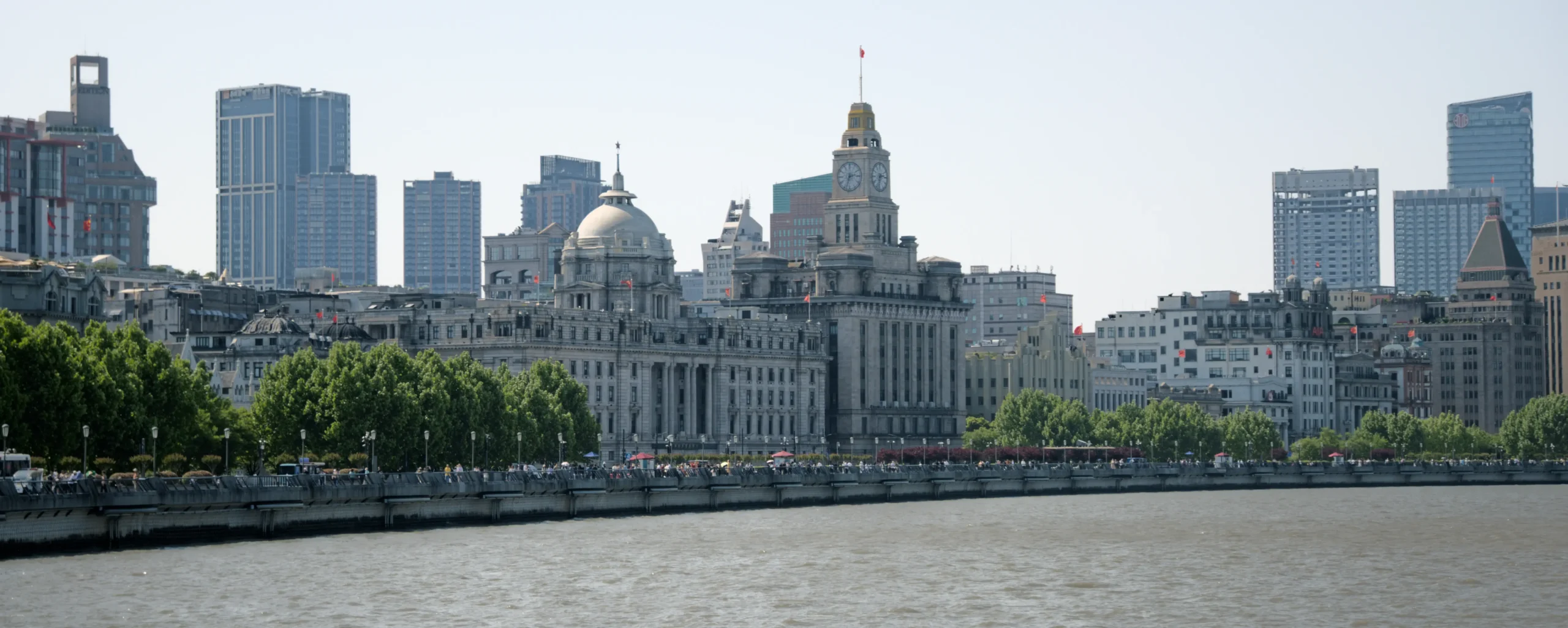
THE BUND
The Bund, known in Chinese as “外滩” (Wàitān), meaning “Outer Beach,” is a prominent waterfront area in central Shanghai. It stretches approximately 1.5 kilometers along the western bank of the Huangpu River, facing the modern skyscrapers of the Lujiazui area in Pudong.
What to do on The Bund?
The Bund itself connect different parts of the central city. You can directly access the Nanjing Road (南京路), which is a 5,5 kilometer long shopping street.
On the coast you can find a ferry to cross the river to the business district. The ferry lays to the south and is cheap and definitely worth it.
Try visiting the Bund at night. It offers beautiful lights with the best view on the Shanghai skyline (featured on the main site!).
History of The Bund
From Mudflats to Colonial Hub (1843–1900)
Following the Treaty of Nanking in 1843, British settlers transformed the muddy riverbank (Huangpu Tan 黄浦滩) into a bustling quay within the Shanghai International Settlement. The term “Bund” comes from Hindi, meaning embankment. The British Consulate, built in 1873, remains the oldest surviving building, marking the area’s colonial influence.
The Golden Age (1900–1940)
The early 20th century saw the Bund emerge as East Asia’s financial center. Grand neoclassical, Beaux-Arts, and Art Deco buildings housed major banks and trading houses, earning it the title “Wall Street of the East.” Notable landmarks included the HSBC Building (1923), Customs House (1927), and Peace Hotel (1929), which hosted global celebrities and dignitaries.
Revival and Modern Era
After declining post-1949, the Bund experienced renaissance through restoration projects in the 1980s and 1990s. Today, it showcases Shanghai’s architectural heritage against Pudong’s modern skyline. The area hosts the Shanghai History Museum, cultural events, and attracts millions of visitors annually.
Leave a Reply